Microsoft AI Courses and Certifications Decoded
Navigating Microsoft's AI certification landscape can feel overwhelming. Eight different exams. Technical and business tracks. Different skill levels. Which one is right for you?
We're demystifying the complete Microsoft AI certification ecosystem—from business fundamentals (AB-730, AB-731, AB-900) to technical developer and expert tracks (AI-901, AI-103, AI-200, AI-300, AI-500)—so you know exactly where to start and how to advance your AI career.
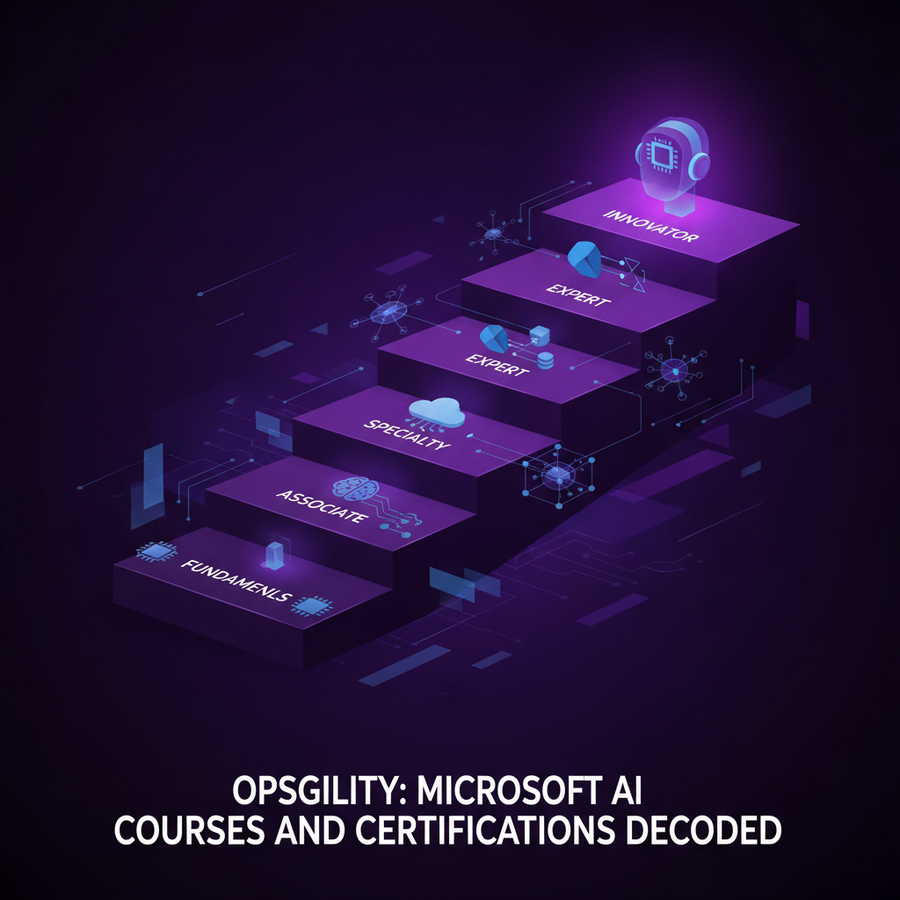
Microsoft's AI certification ecosystem has evolved rapidly. While older exams like AI-900 and AI-102 were retired in June 2026, a new generation of certifications has emerged to reflect the cutting-edge realities of generative AI, multi-agent systems, production MLOps, and business AI transformation.
In this guide, we break down eight critical certifications across two distinct tracks:
- Business Leadership Track: AB-730 (AI Business Professional), AB-731 (AI Transformation Leader), and AB-900 (Copilot & Agent Administration Fundamentals)—for decision-makers, managers, and IT administrators driving AI adoption
- Technical Developer Track: AI-901, AI-103, AI-200, AI-300, and AI-500—for developers, engineers, and architects building AI solutions
Whether you're a business professional exploring AI possibilities or a developer building production-grade AI solutions, you'll find your path here—verified against current Microsoft Learn documentation.
Business Leadership Track
AI fluency, productivity, and transformation leadership—no coding required
AB-730: AI Business Professional
Who This Exam Is For
Professionals from any business function—marketing, sales, operations, product management, customer success, HR, finance—who want to use generative AI productivity tools to improve daily work and drive business outcomes, without writing code.
What You'll Learn
- Understand generative AI fundamentals (25-30%) — How Copilot works, data privacy and security, prompt engineering basics, responsible AI risks (fabrications, prompt injection, over-reliance)
- Manage prompts and conversations (35-40%) — Create effective prompts, save/schedule/share prompts, manage conversations, create and configure Copilot agents
- Draft and analyze business content (25-30%) — Draft documents from prompts, generate summaries, use Copilot in meetings, collaborate with Copilot Pages
Experience Level
Beginner / Business User — No programming experience required. You should be comfortable with Microsoft 365 apps (Outlook, Word, Teams, PowerPoint, Excel) and familiar with common business processes.
Certification Earned
Pass Exam AB-730 to earn:
Microsoft Certified: AI Business Professional
Related Training
Course AB-730T00-A: Transform business workflows with generative AI is a 1-day instructor-led course that prepares you for this exam.
Coming Soon: Opsgility's AB-730 training will be available on SkillMeUp.AI shortly.
AB-731: AI Transformation Leader
Who This Exam Is For
Business decision-makers at all levels who guide AI transformation and innovation within their teams or organizations. You're responsible for recognizing AI opportunities, planning adoption, optimizing business processes, and aligning AI investments with business goals—without writing code.
What You'll Learn
- Identify business value of generative AI (35-40%) — Generative AI concepts, cost drivers (tokens, ROI), when AI adds value, responsible AI principles, machine learning lifecycle
- Identify benefits and capabilities of Microsoft's AI apps and services (35-40%) — Map business processes to Copilot, understand Copilot extensibility, Foundry Tools capabilities, matching AI models to business needs
- Identify implementation and adoption strategy (20-25%) — Align with responsible AI policies, establish governance and AI councils, plan adoption programs, understand licensing models
Experience Level
Beginner / Business Leader — No coding required. You need experience leading adoption or change management, and familiarity with Microsoft 365, Microsoft Foundry, and general AI capabilities.
Certification Earned
Pass Exam AB-731 to earn:
Microsoft Certified: AI Transformation Leader
Coming Soon: Opsgility's AB-731 training will be available on SkillMeUp.AI shortly.
AB-900: Microsoft 365 Copilot and Agent Administration Fundamentals
Who This Exam Is For
IT administrators, Microsoft 365 admins, and security professionals who need to configure, manage, and govern Microsoft 365 Copilot and agents across an organization. You should be familiar with Microsoft 365 admin centers, core security features, and identity and access management.
What You'll Learn
- Identify core features and objects of Microsoft 365 services (30-35%) — Licenses, Exchange/SharePoint/Teams configuration, security principles (Zero Trust, authentication, SSO, conditional access)
- Understand data protection and governance for Copilot (35-40%) — Microsoft Purview features (Information Protection, DLP, Insider Risk, Communication Compliance, DSPM for AI), how Copilot accesses data, responsible AI principles
- Perform basic administrative tasks for Copilot and agents (25-30%) — Assign licenses, monitor usage, manage prompts, create and approve agents, monitor agent lifecycle
Experience Level
Beginner / IT Administrator — Requires familiarity with Microsoft 365 admin centers, Microsoft Entra ID, Microsoft Purview, and basic security concepts. No programming required, but you should understand policies, permissions, and compliance workflows.
Certification Earned
Pass Exam AB-900 to earn:
Microsoft 365 Certified: Copilot and Agent Administration Fundamentals
Technical Developer Track
From fundamentals to expert-level AI architecture and multi-agent systems
AI-901: Microsoft Azure AI Fundamentals
Who This Exam Is For
Candidates at the beginning of a career in AI solution development who need foundational technical skills. You should have familiarity with basic programming concepts, Azure resources, and cloud computing fundamentals.
What You'll Learn
- Foundational AI concepts and Azure AI services overview
- Machine learning workloads and considerations
- Computer vision, natural language processing, and conversational AI capabilities
- Responsible AI principles and governance
- Implementing AI solutions using Microsoft Foundry
- Working with REST APIs, SDKs, and command-line tools
Experience Level
Beginner / Technical Foundations — This is a technically-oriented fundamentals exam. While it doesn't require deep programming expertise, you should have basic familiarity with Python syntax, Azure resources, and API concepts. Ideal for those starting an AI development career path.
Note: The official Microsoft Exam AI-900: Microsoft Azure AI Fundamentals was retired June 30, 2026. Opsgility's AI-901 course reflects updated fundamentals content aligned with current Azure AI services, Microsoft Foundry, and modern AI development practices.
AI-103: Developing AI Apps & Agents with Azure & Python
Who This Exam Is For
Developers and software engineers who are ready to build AI-powered applications and intelligent agents using Azure AI services and Python.
What You'll Learn
- Building AI applications with Azure AI services and Python SDKs
- Developing conversational agents and chatbots
- Implementing document intelligence and vision capabilities
- Working with Azure OpenAI and foundation models
- Agent development patterns and orchestration fundamentals
- Integrating AI capabilities into existing applications
Experience Level
Intermediate / Developer — Requires Python programming experience and familiarity with Azure basics. This is your entry point to hands-on AI development.
Recommended Prerequisite: Complete AI-901 or equivalent business/fundamentals knowledge before diving into development.
AI-200: Developing AI Cloud Solutions on Azure
Who This Exam Is For
Back-end developers and cloud engineers responsible for building production-ready, scalable AI solutions on Azure infrastructure with emphasis on containerization, data management, and integration.
What You'll Learn
- Develop containerized solutions on Azure (20-25%) — Azure Container Registry, Container Apps, AKS, event-driven scaling with KEDA
- Develop AI solutions using Azure data management services (25-30%) — Azure Cosmos DB for NoSQL, PostgreSQL with pgvector, Azure Managed Redis for vector search and caching
- Connect to and consume Azure services (20-25%) — Event-driven workflows with Service Bus and Event Grid, serverless APIs with Azure Functions
- Secure, monitor, and troubleshoot Azure solutions (20-25%) — Azure Key Vault, App Configuration, OpenTelemetry tracing, KQL queries for logs and metrics
Experience Level
Associate / Cloud Developer — Requires proficiency in Python, Azure SDKs, containerization, and cloud architecture. You should understand vector databases, embeddings, and retrieval-augmented generation (RAG) patterns.
Key Focus: This exam emphasizes infrastructure and integration for AI workloads—not training models, but deploying and connecting AI services at scale.
AI-300: Operationalizing ML & Generative AI Solutions
Who This Exam Is For
MLOps engineers, data scientists, and DevOps professionals responsible for the entire lifecycle of machine learning and generative AI systems—from training pipelines to production deployment, monitoring, and optimization.
What You'll Learn
- Design and implement MLOps infrastructure (15-20%) — Azure Machine Learning workspaces, datastores, compute targets, infrastructure as code with Bicep and GitHub Actions
- Implement machine learning model lifecycle (25-30%) — MLflow experiment tracking, automated ML, hyperparameter tuning, distributed training, model registration and versioning
- Design and implement GenAIOps infrastructure (20-25%) — Microsoft Foundry environments, foundation model deployment, provisioned throughput, prompt versioning with Git
- Implement generative AI quality assurance (10-15%) — Test datasets, AI quality metrics (groundedness, relevance, coherence, fluency), risk and safety evaluations
- Optimize generative AI systems (10-15%) — RAG performance tuning, embedding model selection, hybrid search, fine-tuning strategies, synthetic data generation
Experience Level
Associate / MLOps Engineer — Requires data science background, Python programming, DevOps practices, and experience with Azure Machine Learning and Microsoft Foundry. Entry-level understanding of GitHub Actions and CLI tools expected.
Key Focus: This is the operations exam—you're not just building models, you're deploying, monitoring, retraining, and optimizing them in production environments with automation and governance.
AI-500: Designing & Implementing Multi-Agent AI Solutions
Who This Exam Is For
Expert-level practitioners who design, build, and optimize scalable, production-ready multi-agent AI systems and workflows. You manage complex AI projects from architectural design through production deployment.
What You'll Learn
- Architect multi-agent solutions (15-20%) — Designing logical architectures for multi-agent systems and workflows
- Develop multi-agent solutions in Azure (30-35%) — Building agent ecosystems using Microsoft Agent Framework, Model Context Protocol (MCP), LangGraph, and Microsoft Foundry
- Evaluate, optimize, and monitor multi-agent solutions (20-25%) — Performance optimization, monitoring distributed agent systems, quality assurance
- Secure, govern, and deploy multi-agent solutions (20-25%) — Production deployment strategies, security controls, governance frameworks
Experience Level
Expert / AI Solutions Architect — Requires extensive experience developing AI/ML solutions, deploying agentic systems in production, orchestrating agent logic, and working with open-source frameworks. Python proficiency and deep Azure knowledge essential.
Certification Path
The Microsoft Certified: Multi-Agent AI Solutions Expert credential has a formal prerequisite:
Prerequisite Certification:
Pass Exam AI-103 to earn:
Microsoft Certified: Azure AI Apps and Agents Developer Associate
Then pass Exam AI-500 to earn:
Microsoft Certified: Multi-Agent AI Solutions Expert
While you may be able to take the AI-500 exam without first taking AI-103, the AI-103 Associate certification is required in order to earn the Multi-Agent AI Solutions Expert credential.
AI-200 and AI-300 are useful complementary preparation but are not the formal prerequisite certifications for AI-500.
Beta Status & Availability: Microsoft's official AI-500T00 instructor-led course is scheduled for availability on September 30, 2026. Opsgility's AI-500 training is available now on SkillMeUp.AI. The exam is currently in beta and not scored immediately—Microsoft is gathering data on question quality.
Who You Work With
In this role, you collaborate closely with developers, machine learning engineers, platform engineers, data scientists, and business stakeholders to translate complex requirements into production-ready, multi-agent solutions.
The Recommended Learning Paths
Business Leadership Track
For decision-makers, managers, and IT administrators driving AI adoption—no coding required:
AI Productivity User
AB-730 — Use Copilot to enhance daily work, draft content, manage prompts and agents.
AI Transformation Leader
AB-731 — Strategic vision, AI adoption planning, responsible AI governance.
Copilot & Agent Admin
AB-900 — Configure, manage, and govern Copilot and agents across Microsoft 365.
Technical Developer Track
AI-103, AI-200, AI-300, and AI-500 are not simply sequential difficulty levels. They represent different roles and responsibilities across the AI application lifecycle:
Foundational Technical AI
AI-901 — Begin with fundamentals, basic Python, Azure concepts, and Microsoft Foundry.
AI Application & Agent Developer
AI-103 — Build AI-powered applications and agents with Python and Azure AI services.
AI Cloud/Backend Developer
AI-200 — Cloud infrastructure, containerization, data integration for AI workloads.
AI Production Operations / MLOps / GenAIOps
AI-300 — Operationalize ML and generative AI: pipelines, monitoring, optimization.
Advanced Multi-Agent Expert
AI-103 Associate certification → AI-500 — Expert-level multi-agent architecture.
Our Recommendation
- Start with AI-901 if you're new to AI development and need foundational technical skills (Python basics, Azure, Foundry).
- Move to AI-103 to get hands-on with building AI apps and agents.
- Progress to AI-200 when you're ready to deploy production-grade cloud solutions.
- Add AI-300 to master MLOps, GenAIOps, and lifecycle management.
- Tackle AI-500 only after earning the AI-103 Associate certification and building real-world multi-agent systems.
Related Microsoft Applied Skills
In addition to traditional certifications, Microsoft offers Applied Skills—scenario-based credentials that validate hands-on technical abilities through interactive lab assessments. These credentials are faster to earn than full certifications and ideal for demonstrating specific, job-ready skills.
Streamline business workflows with AI chat
Validate your ability to use Microsoft 365 Copilot to streamline web productivity, draft documents, create presentations, manage emails, and explore data.
Products: Microsoft 365 Copilot, Copilot Studio
Role: Business User
Skills assessed:
- Use Copilot for web productivity
- Draft and refine documents (Word)
- Create presentations (PowerPoint)
- Manage emails (Outlook)
- Explore data (Excel)
Build an agent in Microsoft Copilot Studio
Demonstrate your ability to create and configure agents using Copilot Studio, including knowledge sources, topics, tools, and publishing workflows.
Products: Microsoft Copilot Studio, Power Platform
Role: App Maker, Business User
Skills assessed:
- Create and configure agents
- Configure generative AI and knowledge
- Create and configure topics
- Configure tools
- Share and publish agents
Get started developing agents in Microsoft Foundry
Prove your ability to deploy models, create agents, and test agents using the Microsoft Foundry portal for technical AI development.
Products: Microsoft Foundry
Role: AI Engineer, Student
Skills assessed:
- Deploy a model in Foundry
- Create an agent
- Test the agent
What are Applied Skills?
Microsoft Applied Skills are hands-on, scenario-based credentials assessed through interactive labs. Unlike traditional multiple-choice exams, Applied Skills assessments require you to complete real tasks in live environments. They're ideal for proving specific technical abilities quickly—typically taking 1-2 hours to complete versus weeks of study for full certifications.
Quick Comparison Table
| Business Leadership Track | ||||
|---|---|---|---|---|
| Exam | Level | Focus Area | Prerequisites | Ideal For |
| AB-730 | Beginner | AI productivity with Copilot | Microsoft 365 familiarity | Business professionals, all functions |
| AB-731 | Beginner | AI transformation & strategy | Change management experience | Decision-makers, transformation leaders |
| AB-900 | Beginner | Copilot & agent administration | Microsoft 365 admin experience | IT admins, security professionals |
| Technical Developer Track | ||||
| Exam | Level | Focus Area | Prerequisites | Ideal For |
| AI-901 | Beginner | Technical AI fundamentals | Basic Python & Azure familiarity recommended | Aspiring AI developers, technical beginners |
| AI-103 | Intermediate | AI app & agent development (Python) | Python + Azure basics | Developers, software engineers |
| AI-200 | Associate | Cloud infrastructure & data integration | Python, containers, Azure SDKs | Back-end developers, cloud engineers |
| AI-300 | Associate | MLOps & GenAIOps operations | Data science, Python, DevOps basics | MLOps engineers, data scientists |
| AI-500 | Expert | Multi-agent AI systems architecture | AI-103 Associate cert required | AI architects, senior engineers |
Why Train with Opsgility on SkillMeUp.AI?
Live Lab Environments
Hands-on practice in real Azure environments—no setup required. Build, deploy, and troubleshoot AI solutions in production-like sandboxes.
Expert-Led Instruction
Learn from expertly trained AI Instructors that know the technology better than the people that made it (at least as close!).
Aligned with Microsoft Learn
Our courses are continuously updated to match the latest Microsoft certification requirements and Azure AI capabilities.
Ready to Master Microsoft AI?
All eight courses are available now on SkillMeUp.AI with live lab environments, expert instruction, and flexible learning paths.
Browse All AI CoursesLearn About OpsgilityFrequently Asked Questions
AI-103: 2-4 weeks for experienced developers
AI-200: 3-6 weeks depending on Azure and container experience
AI-300: 4-8 weeks (requires MLOps and Foundry hands-on)
AI-500: 6-12 weeks (expert-level with multi-agent architecture)
Opsgility's hands-on labs significantly accelerate preparation by providing real Azure environments.
Transform Your Team's AI Capabilities
Opsgility delivers enterprise-grade AI training with live labs, expert instructors, and flexible delivery—live or AI-powered on-demand.
Start Learning on SkillMeUp.AIContact Sales